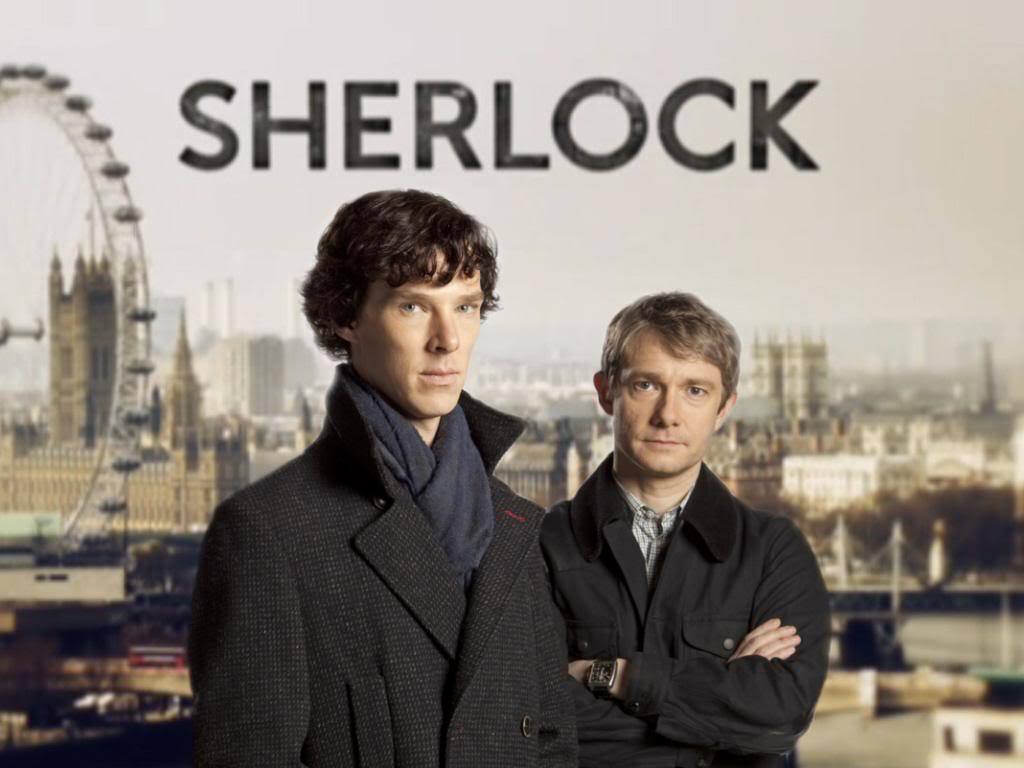
I consulted my friend Sarah on the subject since in the last few years she has become my authority on British television and I figured since it was so popular she had probably seen it. Her response was pretty much, "It's okay. It's really amusing but it doesn't really deserve all the tumblr stuff it's getting. You'll have a problem with how the female characters are written." That last bit set off a warning signal in my head because a lot of the time, writing is the most important thing to me about things I watch and Sarah, like me, cares a lot about how female characters are written since, let's face it, a lot of people don't know how to write female characters.
As you would be able to tell from reading . . . anything else I've written, two of the fandoms that I spend the most time in myself are the Fullmetal Alchemist fandom and the Whedonverse and you know what these both have in common? Well written female characters. Fullmetal Alchemist is a story written for the teen boy demographic that is mature enough to appeal to all ages and genders. It is also written by a woman, a fact that alludes a lot of people because she pulled a J. K. Rowling and adopted a unisex, verging on masculine pen name, Hiromu Arakawa. In spite of the nature of the story requiring there to be notably more male than female characters, there are plenty of women represented and they are all unique, strong, and three-dimensional, even minor characters like Mrs. Bradley and Rebecca Catalina. You understand who they are and what their motivations are and they are neither saints nor devils. Joss Whedon and his squads of writers are also triumphant at writing shows where there is a female main character half the time and the ensemble cast is always made up of nearly equal parts men and women. His women, like Arakawa's, are unique and three-dimensional, and strong in their own ways.
Now, I should be clear that when I say that a female character is "strong", I don't necessarily mean that in a physical sense (or even an emotional sense). She is most definitely not flawless. It's the flaws that make a female character strong and three-dimensional and if she doesn't have any then you have failed character writing 101. The first rule of writing a female character is pretty much to forget that she's female for a moment so that does not becoming a defining trait. There's a fantastic article about the differences in the definition of strong called "Why Strong Female Characters Are Bad For Women" that uses the Transformers movies as an example of how not to write women and talks about how a lot of men seem to misinterpret the phrase "strong female character" into a character that is a flawless expert in some field who is sexualized in a way to appeal to the male audience.
Let me take a moment to get back to Sherlock because I do have good things to say about it. I found it entertaining, extremely well acted, and beautifully directed. These elements alone make the show of a very high caliber above a lot of the tripe you are likely to see on television nowadays. It is definitely a good show. The problem comes in with the writing. While, the show is adapted very well, taking Arthur Conan Doyle's original stories and moving them up to a modern setting, there are some aspects of the writing that irk me. First of all, I was really uncomfortable in the first episode and in many of the subsequent episodes at how many times humor was attempted to be derived from a "gay gag" involving Sherlock and Watson. The first time I laughed a bit but every time after that started to get more and more uncomfortable by how often the joke kept coming up. I started thinking to myself, "Does the show think there is something inherently wrong about two men being roommates? Does it think there is something funny about being gay or being mistaken for gay?" On top of those jokes, the show needed to make it ABUNDANTLY clear that both Sherlock and Watson are straight. Watson is dating girls left and right and Sherlock, in spite of the fact that he seems to be written in a way that would make him make more sense as an asexual (although perhaps not aromantic), is given a love interest as well and his lack of sex becomes a topic for discussion on more than one occasion. There was something a little off about the whole situation to me.
There are other small writing complaints I have about the show that are kind of omnipresent in Steven Moffet's shows like that occasionally things are wrapped up in a way that makes no sense and gives no real explanation for ("A Scandal in Belgravia" was full of these) but when these things happened I tried to just tell myself to ignore it instead of getting angry about it.
Then we enter the thing Sarah warned me about: the female characters.
I think it's probably best for me to break this down one by one to say exactly what is wrong about how the female characters in Sherlock are written.

Honestly, I found this picture on a Sherlock wiki and read the whole ten sentence description of her and there wasn't a single element on the page that said a thing about who she is. She is a characterless character. Then she gets captured, like all useless women do in fiction. In fact, she is the first in what will be a string of useless women only around to date John and remind us that he A.) isn't gay and B.) can't hold down a relationship because of the chaotic life he leads. Wouldn't it perhaps be more interesting and emotionally compelling if we actually knew who she was? What if she made some appearances in other episodes and the audience started to like her as a character and then she and John broke up because of the aforementioned chaotic lifestyle and we actually got a real impression of how much John's friendship with Sherlock is affecting his private life? Even if a character does exist for furthering the development of a more important character, this does not mean they should just be a figure no one will remember. I couldn't even remember her name until I looked it up on IMDb.
Sgt. Sally Donovan
 And while we are on the topic of useless female characters, we have Sgt. Donovan. I didn't even know she had a first name until just now. Sgt. Donovan is around a bit more than Sally and actually has the barest minimum requirement of character to have appeared in three episodes out of six. Here's what we know about her: she hates Sherlock because he likes crime and she thinks he's going to turn into a crazy murderer and at one point she had sex with one of her coworkers which was clearly played for laughs. That's all I've got. It's all well and good to have a detective character who thinks Sherlock is overstepping their boundaries and could even be dangerous, not everyone on the force is likely to have Lestrade's tolerance for him, but I feel like there's something missing from all this hatred. Shouldn't there be some kind of experience in order for her to draw this assumption? A past case? Something Sherlock himself did? Also, why is she always angry? Seriously, every scene she is in, she is pissy and angry. She's certainly around enough to become a real character so why hasn't she become one yet? Any real trait to show she's a person would be lovely.
Mrs. Hudson is probably the female character I have the best understanding of. I don't necessarily mean she is the best developed character or that she's the best written female character (although, truthfully, she may be). What I mean is that I understand and accept her purpose and why she is written the way she is far more than I understand and accept the logic behind the other female characters. Mrs. Hudson is a parody of the landlady caricature. It has appeared enough in literature, film, and television: the older widow who is very sweet and protective of her tenants and likes to meddle in their lives. The parody aspects comes in with the fact that no matter what utterly ridiculous thing Sherlock has done, she still maintains that sweet, concerned nature typical of her caricature. Finds a severed head in Sherlock's fridge? Scolds him that he put it in the same place where he keeps his food. We even get to see a bit more of her strength in the scene where she exercises her acting chops for Sherlock's sake. We don't ever really get an explanation for why she is so cool with Sherlock's weirdness and I kind of wish we did because I think it would be really interesting and would kind of fill in a missing piece to her character but I'm not going to hold my breath. The writing of the show in general doesn't care much for filling in missing pieces and I doubt they would waste their time on a character who is just a parody and comic relief but since she is the most easily likeable female character on the show, I wish the writing would acknowledge this more.
Molly Hooper

Now Molly. I want so hard to like Molly but I always just end up pitying her. Like Mrs. Hudson, she appears in the show a lot because her career is important to the lives of Sherlock and Watson but Molly for 95% of the show spends her time pining after Sherlock and getting rejected over and over again. She's the Eponine. In spite of this unfortunate role she was saddled with, Molly has actual personality traits: she's friendly but kind of awkward, she has a high tolerance for the disturbing, and, as I was overjoyed to hear, she is very perspective to people's feelings that they keep hidden. Molly's most significant moment on the show is definitely at the end of season two when she reveals herself to be the only person who is really capable of seeing beyond Sherlock's exterior traits. She explains that her father was the same way, which actually makes sense, and in a way this explains her attraction to Sherlock the entire time. She likes him because of the potential she sees underneath as well as the exterior. After having nearly sat through the entire show without seeing any kind of development in any of the female characters, this was a breath of fresh air and I sincerely hope that Molly will be given more to do in season three. This is an important development in both her character, Sherlock's, and their relationship and I am terrified that this will be abandoned by the writers for something that they deem more important. I would love to see a kind of friendship or even therapist-patient relationship crop up here. I'm rooting for Molly's development!

The sound my frustration makes is: Auuuuuuhhhh. I don't even know where to start here. The original Irene Adler was an American opera singer who had some high profile affairs. She's clever, sexy, and international and in some materials is a sort of love interest for Sherlock. Now imagine that you have to take that information and put it in a modern context. When I do that, I get Irene Adler as a lead singer of a rock band or a pop singer who has had a lot of high profile affairs who has connections everywhere in the world because of all the touring she does and manages to be famous but lead a sort of double life where what is published in the papers doesn't even graze the surface of what she has really done. Now put that through a "poor male writing" filter and what do you get? You get Sherlock's Irene Adler, a famous dominatrix who has incriminating pictures of a female member of the royal family who is a client of hers and has connections around the world. Now, I can't stress this enough, the problem is not that she is a dominatrix although it is a fairly poor translation of the original material. I'm no prude and I have no damage against sex workers. It's also by no means impossible to write a female character who is a sex worker who can be liked by both sexes (Inara Sera from Firefly anyone?). No, the problem is how her occupation affects every other aspect of her character. As I said before, the female characters of Sherlock are all well employed but their jobs don't really define anything about them. This is not the case with Irene. The dominatrix thing comes into play all the time with her speech and behavior. She is almost always overtly sexual which makes her kind of hard to relate to and makes it hard for any other personality traits to seep in. The virgin-whore complex is in full form here with Molly as the pathetic virgin and Irene as the male fantasy whore. I think she would have been more appealing to a female audience if she was a dominatrix but treated her work like a private thing that doesn't factor into her personal life. Then there's the matter of her cleverness. Like the article I referenced before, one of the defining traits of these poorly written female characters is their expertise in a field where they trump all their male counterparts, made okay to a male audience by their sexuality. Although Sherlock does ultimately defeat Irene at the end, she outsmarts him throughout most of the episode she's in and does so in ways that Sherlock can't even comprehend. Also, this is utterly besides the point but I was also kind of hoping Irene would be American because the representation of Americans on Sherlock (and Steven Moffet shows in general) is absolutely atrocious. They are either violent, bigoted, or stupid or any combination of the three.
I think what makes me most sad about Irene is that while Molly has shown signs of being a retrievable character, I'm not sure if Irene is. It's totally possible that she could come back into the show, humbled by her defeat, and become a character everyone could really love but I guess I'm a bit cynical.
Dear Steven Moffet,
A homework assignment: before season three of Sherlock, please watch any two Joss Whedon shows and read at least 3/4 of Fullmetal Alchemist, paying close attention to the female characters and then attention to how they are written in comparison to the male characters and how they function in relationship to them.
- Kay

No comments:
Post a Comment