Thursday, April 18, 2013

Why Lana Del Rey?: A Music Analysis

This is a question I have asked myself every day for the past week as I got into my car to go to work and I realize that her CD is playing in my car. It's not like someone put it there for me; I very knowingly have her CD in my CD player. I got her music and burned a CD of it for the sole purpose of playing it in my car. The thing that I am still blurry on is why I decided that I needed her music in my life and how I should feel about this decision.

Ever since hearing "Video Games" for the first time I have been unable to shake the fact that I like her music in some unexplained way but that I really feel like I shouldn't. To be clear, I looked for the song on YouTube after hearing a Hunger Games parody of it so I didn't have any knowledge about the song or the singer behind it and I still know very little. In truth, I am pretty detached from pop culture as a whole. I keep up with movies fairly well by using Flixster but the only television shows I keep up with are Community and Mad Men and I will often go days without ever turning on a TV, the only books printed in the last 30 years that I've read have been recommended to me by friends, and I know nothing of pop music outside of Todd in the Shadows (I don't even listen to the alternative station on the radio anymore). And don't even get me started on celebrities. I know nothing.

I have no judgment of Lana Del Rey, the human. I know nothing about her aside from a vague idea of what she looks like. Everything I could possibly gleam about her personality comes from her music and that alone makes me think that I would actually really not like her as a person. This fact makes listening to her feel like a guilty pleasure to me. She, or at least her persona, seems to have multiple personalities and I don't like almost all of them.

For that reason perhaps, maybe I should take this on a song by song basis of judgment. I will do this with a clear mind and without looking somewhere like songmeanings.net or her Wiki page. I certainly don't like all her songs but on the whole I like her and want to hear more from her so she must be doing something right:

Born To Die - The Paradise Edition (2012)

1. "Born To Die"
I'm pretty sure this is one of my favorite tracks on the whole album. It blends her two music styles (heavy, sad retro-ish beats with hip-hop) in a way that I really like. The lyrics aren't exactly her most memorable or her most focused but their simplicity is fine with me because it's really a mood that this song is going for more than anything. That mood is a bitterly realistic carpe diem and I totally buy it.

2. "Off To The Races"
Every fiber of my being tells me that I should hate this song. I should but I really, really don't. This is one of the least ambiguous songs on the album. It's about a party girl mess who is with this rich older guy who is her financial enabler. She messes up and he saves her and this is the essence of their love. A symbiosis of calamity. The narrator is unsympathetic and insincere about her feelings, sounding like she is the perfect manipulator and he sounds like he just wants a hot chick who depends on him. The end conclusion seems to be that this fuckery means true love because ultimately they can't be without each other.
So if the premise kind of makes me sick, why do I like this song? The wordplay. I am a sucker for good use of language and the choruses of this song are genuinely clever in their rhyme and pattern in a way that is also annoyingly catchy. It's not the prettiest song in terms of music but I just love the flow and although the premise of the song means I should hate it, I really respect how it is a complete idea and executed in a way that gives you the right atmosphere for what is being conveyed.

3. "Blue Jeans"
Having this song come after "Off To The Races" is endlessly confusing to me. This was the point I realized Lana Del Rey, at least in her music, is many people. Specifically, she's many emotionally tortured people in love. The last guy was a rich, old, cigar-smoking, gold-chain-wearing dude and this guy is a sorta-punk-rock James Dean figure in jeans and a white shirt. Essentially she went from something like this:


to this:


Although when I hear this song, it conjures a lot of variations of the same idea:


What do you mean I have a fetish for this look? Why would you say that?
Aside from the description of the guy this song isn't particularly memorable to me. She'll love him forever but he randomly got up and left because that's what rebels without causes do. The music sounds like any of her other songs that fall on the melancholic side of the scale over the vague hip hop side.

4. "Video Games"
I have heard this song 20 times and I still have trouble figuring out what the heck it's supposed to be about. It's not the most confusing song here and it seems to be really trying to say something but I kind of struggle with what that is so here's my interpretation: This song is about distraction and attention. She loves this guy and will do anything to get his attention but he is often dismissive of her because he is so wrapped up in the joys of the modern world. She is only able to finally get him to notice her by joining in his activities and becoming just as absorbed in the superficial and distracting. Basically, she's in love with a frat boy. Or an very social nerd. I'll go read an interpretation after this and realize I'm way off but that's my idea and I'm sticking with it.
As for the tune, it's really the music itself that seems to have drawn me to Lana Del Rey in the first place and this song would be the one most responsible. A lot of the music I listen to is of the genre-blending variety and is usually about tragic love so it almost seems like this song was what I usually listen to run through a heavy pop filter.

5. "Diet Mountain Dew"
I think this song is about nothing. It's just about road tripping to New York or something. I acknowledge that this could actually be a personal inside joke or something but otherwise, the lyrics are utterly inconsequential.
Musically, there's not much of note here. It's more on the hip-hop happy side of things and there's nothing about this song that is inherently offensive but there's nothing really worth noting. If this is anyone's favorite song, I will be floored.

6. "National Anthem"
I still have no real idea what is meant by "I'm your national anthem" but in spite of this, the song still does make sense to me even if it seemed a bit jumbled the first three times I heard it. I think she's describing a one night stand interspersed with other examples of indulgence like money, drugs, and fancy things. I honestly think the chorus is really nice at the "red, white, blue" bit but I'm not a huge fan of the rap-like nature of the choruses. I can respect well-written rap and this just isn't all that impressive to me.
It's at this point in the album when I start to get exhausted by all the repeated themes and lines and wonder if there's anything else she can do since I haven't been particularly interested since the very beginning. . .

7. "Dark Paradise"
. . . And then I say thank you! This is definitely one of my favorite songs of hers. It's a little underwhelming in the beginning and the bit about the "singing your song" comes off more lazy than evocative to me but the bit before the chorus and the chorus itself are really pretty. It's the heavy sadness in her songs that drew me to her in the first place so obviously her most depressing song would be a favorite. The lyrics are obviously about a dead lover and while they are simple and not particularly unique, I just love the way she sings them and the rhythm which almost makes me think of a flowing river.

8. "Radio"
I kind of hate this one. The lyrics are silly to me and the overly sweet nature of the song is so strange when she's essentially telling this guy who she likes to like her back because she's famous now. Annoying premise, annoying style, and strange analogies that don't fully work. Cinnamon isn't really sweet. Sugar venom isn't a thing. Who licks vitamins?

9. "Carmen"
This song pretty much sucks me in from the beginning because I am a sucker for strings, especially dirge-sounding strings, and my interest in the music continues throughout the whole song even when they go away. As for the lyrics, it's nice to hear her tell someone else's fame story other than her own, especially one that is so bitterly realistic and there's actually some really good writing here. My big problem with this song is the flow of the lyrics in the choruses. Actually, maybe it's not the flow. Maybe it's her singing. Or maybe I'm not a fan of the looped voices. Something about it sounds incorrect to me. It doesn't deter me from liking the song but I cringe a bit during the "laughs like God" line.

10. "Million Dollar Man"
This was kind of the song I was waiting for from finding Lana Del Rey: a straight up throwback song. I think this is some of her best singing (or at least most controlled) and everything about this song kind of makes me happy that it exists. My one problem with this song is her pronunciation of "flower" in the first line. Pains me every time.

11. "Summertime Sadness"
I don't really know if this song makes sense but I think it's supposed to be more of a feeling song like "Diet Mountain Dew". Point is: it achieves it's goal perfectly and I love listening to it. Who cares about the flaws (okay, the stutter trend in music makes me angry but still)?

12. "This Is What Makes Us Girls"
I really love the story telling in this song and it's really strong lyrically. It's not a very unique song musically, especially at this point in the album, but I think it's a really great end to the album if you don't have any of the extended stuff. While I kind of disagree with the thesis of the song, it is kind of the perfect thesis for the album as a whole which is why it fits so well at the end. Almost every song is about a tortured romance of some sort but this one is about friendship and how it can get ruined or pushed to the side in pursuit of love. I see what you did there, Lana.

13. "Without You"
This song thematically is kind of a response to "Radio" that feels far more honest. It's pretty much about, screw the fame because it means nothing without you. It's not sugar-coated in any way and it's actually very desperate. I'll take this one over "Radio" any day.

14. "Lolita"
This song for me is a case of, "I see what you were trying to achieve with this song but I still hate it." This beat is utterly migraine-inducing and the childish rhymes and singing come off more creepy than clever. The message is conflicted and not like the singer is conflicted but like the lyrics don't know what they are trying to achieve. I always skip this one and think of "Gothic Lolita" by Emilie Autumn, a song with a similar idea but a million times better executed.

15. "Lucky Ones"
Hang on, everybody! This love story isn't tortured almost at all! It's happy! This song actually reminds me of a song from a musical. Hell, this song could be the last song of a musical that was a love story where the couple just couldn't get together until the very end. This is your happy ending. See, I can like happy. I just like realistic happy over something that will rot my teeth.

16. "Ride"
This is the first song on Paradise and I really think it's one of the strongest. It's got this nice folksy sound that fits well with the road tripping idea. Lana Del Rey likes to evoke feelings of "Americanness" in her songs and I feel like this one achieves that the best. It's not about fame or excess or tortured love but just about being disaffected and trying to get away with endless road ahead of you. If this song doesn't end up during the climactic scene of a movie, I will be utterly shocked.

17. "American"
This is the first of three songs that sounds to me like there was very little effort put into them. The subtext of Americana has rapidly become in-your-face text and the rest of the lyrics aside from that amusing conversation in the beginning feel like they were just tossed together. Also the beat puts me to sleep. It's not even minimal, just boring.

18. "Cola"
This is the same song, right? Just with even weirder lyrics that fit together even worse and a much better beat?

19. "Body Electric"
More random statements about herself mixed with a repetitive chorus. Is this song about anything (other than dancing maybe)? It was at this point I really wondered why there was not more effort put into this. It was churned out not long after Born to Die. I hope this isn't a prediction for the future of her music because if so this might be the last CD of hers I will have.

20. "Blue Velvet"
When I saw this song on here I laughed in joy and relief. This choice of cover is almost too spot-on. I love the original and she sings it just fine. It's not one of those covers that really changes the way you look at the original but it does it justice.

21. "Gods & Monsters"
I kind of knew I would like this song from the title. Never judge a song by its title but really, I couldn't resist. It's a typical theme of overindulgence like "National Anthem" but with far more interesting lyrics. I really love the metaphors in this song. Lana Del Rey seems to really like analogies and uses them to varying success.

22. "Yayo"
Another throwback song! I like the sound of this song but if I was standing in the recording booth I would be shouting, "Diction, please!" The lyrics are so fifties I could cry in joy. One question though: what the heck does yayo mean?

23. "Bel Air"
This is a really different sound in a lot of ways, particularly the chorus. I think the instruments are pretty but overall, I don't really know how I feel about this song aside from thinking that this isn't a great choice for the last song on an album. I'm pretty sure it's just about the singer wanting forgiveness for cheating and there's not much to say about the lyrics because it's the sound of this song that is most unique. I just don't know.


So Lana Del Rey has some songs that I really like and some that I really hate but I think ultimately, she comes out on top in my book. If nothing else, she has a very unique sound that appeals to me in a lot of ways. I like the sadness, the pain, and the bitter realism. Her lyrics are uneven and sometimes she repeats herself a lot but someone can be broken of that. I really like when she does throwback songs but I think I actually like her own personal sound more as long as she has control on how the feel of the song is supposed to blend with the lyrics. I prefer her dark beats to her hip-hop ones but there are a lot of times where they are well-suited ("Off The Races") and times where the two styles are put together ("Born To Die", "Summertime Sadness") in a way that I really like.

All in all, I have to say that I feel better about liking her now that I know why.


[**UPDATE (4/21/13): "Young And Beautiful" is perfect.]

Tuesday, April 16, 2013

Running Away

The first time I ran away from home I was 13 years old. I remember all of it far more distinctly than anything else that happened to me when I was 13 because the age lacked all the depression and anger of being 12 but didn't have the fun and respect associated with being 14.

I was on vacation in Cape Cod with my mother, brother, and our neighbors who had a son my age who was my best friend when we were about five. I had been swimming in the nearby lake when I decided to go back to the house. I think it was because I was either being made fun of by my brother, neighbor, and his father or because they were ignoring me and I would rather be alone if I'm going to be ignored. Back at the house my mother and neighbor's mother were sitting on the deck chatting. I had come in and told my mom why I left which instigated a fight. I don't specifically remember what the fight was about but I know that it had something to do with my mom making a statement about my personality that I believed to be false and her ignoring me when I tried to refute it. This is something I still get into fights with my mom about and I'm 23 years old.

Eventually I got so sick of her refusing to listen to me that I shouted out, "I'm leaving and I'm not going to the pond!" I waited a moment to see if this would cause a reaction and when it didn't, I made good on my promise and walked out. I followed the street past the pond, running past it quickly to avoid being seen by anyone, and then just kept on walking. I passed recently built mansion-like houses that made our family house built by my grandfather and his sons look like a hovel. I passed a surly teenager going home and a couple with a dog that I stopped to pet. I walked until the street wasn't paved anymore and I was on a dirt path. And I should note that at the time I was in my bathing suit, no shoes, and didn't have my contacts in so the world was blurry and I looked like a mess.

I walked until the path ended, the endpoint being another lake that I waded into out of curiosity and by this point I decided that I was tired and my anger had mostly dissipated. I figured the long walk back would resolve whatever remained. It was only when I got back that I realized three things:

1.) I had managed to walk into the next town. Cape Cod does have fairly small towns but it was still quite an accomplishment.

2.) I had been gone over four hours.

3.) My mother hadn't heard me correctly and had called the police.

I returned just as the police car was pulling into the driveway and I was treated to a shouting fit by my mother who demanded that I put some clothes on and get in her car. I was confused since in my mind I had told her exactly what I was doing and had given her the chance to stop me. Then I hyperventilated thinking that she was going to drive me all the way home as punishment.

Instead she drove me to a cafe, got me a frozen hot chocolate, and cried at the table about how she thought I had been killed while telling me about the murder of a lifeguard not much older than me in Truro a few years back. Then she took me to an art show.

Unrelated but my mother has weird ways of coping when I do something she thinks in wrong. One time when my best friend and I had kept her up all night by talking in the living room until dawn, she found us together in the morning, freaked out thinking we were having sex and I was apparently going to get pregnant and drop out of school (silly things both because I have had a sufficient sex education, I had just graduated from school so dropping out wasn't really an option, and he and I weren't having sex anyway), and reacted to all of this by shouting at me and then taking us to breakfast. A few months later, she decided that she liked him so much, I should marry him even though, as I said, we were not together.

The point is, this running away from home was the first time I got a taste of wanderlust and ever since then I feel like I have been trying to escape further and further. When I was younger I did similar things but they were not as drastic: exploring the woods, walking to a friend's house without telling my mom, etc. But this was the first time I got really far and felt like I had succeeded at traveling.

By definition, I was kind of a good kid. I didn't do drugs or drink before college or get very drunk even now. I kept any aspects of a love life secret and didn't let it control my life. I always did my homework without being asked ever since I started school. I made friends who were sometimes not the best people but who were always polite to my mother in a genuine way. But here's the thing: I was so fiercely independent a lot of the time that I didn't let any boundaries hold me down. I always did whatever I felt like doing. I always felt safe doing things on my own when my mother thought I needed to be protected. And this has been a constant frustration for her as recently as last summer.

After my running away stint, I started walking every time I was upset. I would leave the house, usually not telling anyone, and would just walk until I felt better. I would try to find new things every time I walked.

As I've gotten older and my freedoms expanded, I have been searching for more and more places to run away to. First my friends started driving and we would start traveling around the state. Then I went to college almost two hours away and learned how to use public transportation to get me where ever I could afford to go. If I wanted to run away to New York, I could and I did. If I wanted to run away to Syracuse, I would. As long as I had the money to go and a couch to sleep on, I would run every chance I got.

Now I'm out of college and have a steady job that enables me to run even more often. I find very little value in material purchases anymore, choosing to pay for experiences. As long as I have a car to take me to work and travel, a computer to entertain, and money to pay for gas, food, car insurance, and government loan payments, I have all I need. I hardly ever buy new clothes and I rarely buy movies, music or books since I just borrow from friends and abuse my library card. I need that extra money normal people use to buy new TVs on running away.

Last summer, I broke another boundary by running away to London. The previous Christmas the only thing on my wishlist was a passport and receiving that little book was like being gifted with the world.

This year I have run away to Boston and New York on numerous occasions (they are frequent places for me as I know people in both cities and I used to live in Boston myself) and will be running again to England, road tripping from London to Bath, Bristol, and Exeter (and possibly more) and then running off to Dublin. I'm in the process of planning another run to Washington DC and still need to fit a run to Montreal into my schedule at some point since I have wanted to do it for years.

Other people have expressed a lot of jealousy at my running, wishing they could run away as much as I do and to the places I do but the more I think about it, the more afraid I get that one day I will have nowhere to run to. I have a lot of places I can visit and couches I can sleep on but eventually I will not have enough money to get away as much as I need to. Eventually the places I want will be unfeasible and the thought of being stuck in suburbia with too many things boxing me in scares me.

You may think, if that kind of life scares you, why don't you avoid it? The fact is, while I may manage to escape a lot I have college loans to pay, I work at a job where I don't make much and there is very little room for promotion, and I still live at home. Every day I get up and go to my suburban job and think, what if I never find a way out and I am only able to remain sane because of my running? That's all that supporting me now. What about in five years when my paycheck can't support the distance I need to travel to feel okay again?

And what if I do get out? What if I manage to move to Boston or some other city that feels more free than here and then I lose a place to run because it has become my new prison?

Will I ever be happy in one place again?


Saturday, January 26, 2013

2013 Potentially Oscar Nominated Movies

This year I feel like a lot of my feelings on movies were heavily influenced by how I felt about the direction, more so than with other years. Also, I think I am getting increasingly critical (cynical) of what I watch. As of right now I have seen 1423 movies in my life and most of them are ranked above three stars so they are mostly not things like Michael Bay films. I have seen a lot of the so called greatest movies ever made and the more I see, the more difficult I am becoming to impress. I don’t know how Roger Ebert can do it.

As usual I will be including movies nominated for Oscars (especially Best Picture, Actor, Actress, Director, Animated Film, and Foreign Film), Golden Globes, and other movies that got a lot of hype or that I feel are of note. If I don’t include that last category I usually end up not able to talk about other movies I have seen this year that deserve to be noted (like Drive, Shame, and Melancholia last year).

Also like previous years because of my hatred for having so many nominees for Best Picture, I will be marking my five picks with an asterisk and any movie mentioned that was not nominated for an Oscar with a plus sign.

Previous Years:    2011     2012


Movies I Really Liked:

Django Unchained*: This is the feel good movie of the year . . . or at least it was for me. I saw it on Christmas with my BFF Adam and his dad and grandma and we all left the theater smiling. Nothing like a Tarantino movie to bring people together for the holidays. I don’t know what to say about how much I loved this. The cast is ridiculous, the movie made me laugh hysterically, clutch my armrest in fear that the heroes wouldn’t succeed, and even avert my eyes from two scenes that were actually a bit to brutal for my usually iron clad stomach. Things are not sugar-coated in this movie until the happy ending is earned and you can leave feeling like it was all worth it. I could make a joke about DiCaprio’s Oscar snub but I won’t. I just want to point out that obviously he was working for that Oscar; his two costars both have already won them!

Argo*: This is a movie I really need to rewatch because when I saw it in the theater I was so wrapped in the plot that I wasn’t paying attention to much else. It’s a great example of a movie where the conclusion is not the important part; it’s how you get there. You know how the movie is going to end but damn is it not good at making you wonder and worry. It helps that it’s also an interesting moment in history and one that is pretty relevant to current conflicts. My only problem with this movie is that I have a hard time distinguishing between a good movie and a good story. I think I’ve settled on “it’s a good story but the movie makes it a well told one.”

Zero Dark Thirty*: This was a movie I kind of expected to hate. I wasn’t a big fan of The Hurt Locker and in particular, Kathryn Bigelow’s nauseating way of shooting scenes so I kind of rolled my eyes at this movie. I was really surprised to find that I kind of loved it. It is more of a mystery and a character study than anything else with a brief side journey into a war movie towards the end. Although I found it hard to get into at first because of my previously mentioned negativity, at a point it hooked me and I could not look away. Jessica Chastin, who I had no previous opinion of in spite of seeing her in a ton of films, was fantastic. Also, I have to note that the end scene of this movie is utterly perfect and I can be a real sucker for a perfect end scene. If I have any complaints it’s that the movie can be a bit too sporadic during the beginning, jumping around from scene to scene without any real establishing or development of any character other than the main but I think with a movie of this scene, to do so would probably be a bit tedious.

Beasts Of The Southern Wild*: This movie smacked me upside the head and I am still trying to figure out what happened. I know that it was beautiful and probably the most unique movie of the year and that it seemed to be successfully doing exactly what last year’s Tree of Life was trying to do but without any of the nonsensical musings or pretentiousness. This is one I will need to watch again if I want to be more coherent about it but I can just say for now that this was great.

Moonrise Kingdom: I never am quite sure how I feel about Wes Anderson movies but I know what I thought of this one: I thought it was adorable and beautifully made. Usually I have a problem with things that are too sentimental but this movie just felt so sincere and never tried to play with my emotions like other movies of the sort might. I actually got a few laughs out of it and I loved the 60s setting. This movie perfectly captures what it is like to be twelve years old. 

A Royal Affair: I have seen a lot of historical drama movies so a movie with a setting in the 1700s or 1800s about a monarchy has to really do something special for me to sit up and take notice and damn, this movie did. First of all, this movie is not just about a marriage affair like I thought it might be but in fact, a gigantic change in the political face of Denmark. This is a movie of epic proportions and it’s beautiful and constantly intriguing. It’s a long watch but damn is it worth it.

The Sessions: This was a fascinating film that I find I have very little to say about. I don’t know why. It was really good, had a really unique premise and great execution, good acting; I’m just stuck. Maybe it’s because I’m writing this one after having written a bunch of others and I’m tapped out. Yay, for character studies!

The Best Exotic Marigold Hotel+: I saw this movie on a total whim while in Cape Cod with my mom where the nearest theater only showed four movies and this was one of them. It was a really fun movie with a lot of interesting characters who each had their own story to tell that showed different aspects of finding a new life in your old age and the idea of finding yourself in a strange land making it relevant to someone of any age. “It will all be alright in the end. If it’s not alright then it’s not the end.”

This Is Not A Film+: I don’t know who has seen this movie but I think it definitely deserves recognition for one reason: it was smuggled out of Iran and into the Cannes Film Festival on a flash drive hidden in a birthday cake. It’s a documentary (kinda) about an Iranian filmmaker under house arrest. Ten minutes in I was wondering why I was watching home movies of a guy answering calls and feeding his pet iguana but thirty minutes in I realized I was watching something kind of brilliant. I kind of hope most of it wasn’t scripted but there are some parts that are so thematically significant that it’s hard to believe they are spontaneous. Certainly not a film for everyone but I really loved it.

Cabin in The Woods+: Joss Whedon had two movies come out this year (almost three; Much Ado About Nothing isn’t coming out officially until June 2013 and I can’t wait) and I actually thought this was the better of the two. It had the right amount of horror and comedy, well written and likeable characters, and it’s a fantastic deconstruction of the horror genre that then takes all the conventions and turns it entirely on its head. Of course, if you know Joss Whedeon’s work with television, the end might not shock you as much as the regular filmgoer. I personally laughed at how typical it is for him but, no spoilers.

Perks of Being A Wallflower+: Having the writer of a book direct the movie of it turned out to be a perfect combination here. I love pretty much everything about this movie: the directing, the adaption of the book, the acting, the accuracy of the time period (one I actually lived though and can remember well). One of the best coming of age movies ever from one of the best coming of age books ever. It’s actually kind of tragic how movies that are directed at a teen audience are so easily overlooked for awards.


Movies I Liked:

Lincoln*: I wanted to like this movie more than I did and sometimes that can be a real killer. Don’t get me wrong; it’s a great movie and everyone else can tell you why. Problem is, in spite of me rating it with an amount of stars that could place it in either this category or the above (4 stars; more than four is automatically above and less is here or lower), I had to only put it in “liked”. I blame Steven Spielberg. I am done with Spielberg. Seriously. His directing style is so sentimental and utterly uncreative at this point that all his recent movies feel old. Like with War Horse (which was quite inferior to this one), there was a scene where I just groaned out loud at a directing decision. This time it was a shot of a flame in Lincoln’s bedroom after he died that Lincoln giving the Gettysburg address is superimposed onto. Way to try to pull emotion from your audience. I do not appreciate manipulative directing. Those feelings should be earned. For my last pick for Best Picture I was torn between this one and Life of Pi and while I think Life of Pi is actually probably a better pick, I caved on this one. I may change it.

Silver Linings Playbook: Ugh. I really, really liked this movie at first and then the last half hour just took it down so much for me. In the beginning this movie was really interesting with all this great acting (Jennifer Lawrence is perfect. In general) and this great theme of everyone seemingly crazy even though only two of the characters are seen as such by the rest and then for some reason it takes this weird turn where suddenly everything is based on a superstition and a dance competition and in the last few minutes we are full on romantic comedy cliché. I’m starting to come to the conclusion that this is the kind of movie David O. Russell makes: a movie that is really strong until you get to the last half hour.

Les Miserables: I can’t say anything about this movie that I haven’t already said. Click here.

Flight: This was a really solid movie that I was ultimately lost interest in as it went on. The first half hour is incredibly strong and then I feel like it kind of limps along to the court hearing at the end. Denzel Washington’s performance is very good but as a movie I only liked it.

The Impossible: This is one of those movies that are mostly based in suspense and emotion. It was certainly solid but for me I think I was having a hard time with it because I kept thinking of the movie Hereafter which also has the topic of the Southeast Asian tsunami as a portion of it. I love a good emotional drama as much as anyone but I didn’t feel like there was much new to be said here that I hadn’t seen in other disaster movies.

Rust And Bone+: There was so nice directing, acting and themes here but I had a problem with the flow of the plot. Aspects of the story-telling seemed to clunk along without reason and it kept bothering me that the characters didn’t seem to be acting like normal human beings. For instance, after Marion Cotillard’s character gets in her accident, she decides to call some bouncer who drove her home from a club one night? Who does that? Also, everything is wrapped up in the end really strangely to me. He runs off but his son nearly dies so he realizes he’s in love? There’s so much missing here.

Cloud Atlas: If I had an “underrated” section, this would probably belong there but alas, I do not. Although, I’m not so sure if it’s that this movie is underrated or that I think the reasons why people are complaining about it don’t seem like valid complaints to me. The people who hate the idea that all the main characters are the same person are missing the point to me. I didn’t even look at it that way. I just looked at them as people whose lives are connected because each has an effect on the other. I think it makes more sense to look at it as each character played by the same actor is the same person. The visuals, camera work and such are all fine. The make-up is occasionally uncanny valley (all the white guys made Asian look like Benedict Cumberbatch) but I saw this as a Brechtian choice and not a realistic one. So why didn’t I like this movie as much as I had hoped? Each individual plot was interesting but only as a very short story. Everything was drawn out WAY too long and so something interesting in a small dose becomes exhausting.

Dark Knight Rises+: Christopher Nolan really knows how to create a masterpiece around a theme and what he has done to the Batman canon, as a Batman fan, gives me so much joy. His modern take is certainly something the world needed. The main fault with this movie that kept me from loving it was that there were a few too many lapses in logic for me. One lapse actually made me burst out laughing. There really needed to be some red pen action with the script because a lot of things were inconsistent or out of nowhere. The ending was great though; just wanted to say that.

The Hunger Games+: As someone who loves the books, I am not going to get hung up on things they left out because that would be utterly useless. This is what I will say: this movie was perfectly cast but the directing was often nausea inducing and the film really needed some small details to help make the plot make sense to someone who hasn’t read the book. Also, the lightning was sometimes egregiously bad. Hopefully a change in director will mean an improvement for the next film.

Pitch Perfect+: I honestly thought this movie could be really stupid but considering how much my friends liked it, I eventually gave in and watched it. It actually brought a smile to my face and gave me a few really good laughs. The music is obviously, awesome and I kind of love how self aware this movie is. Anna Kendrick and Rebel Wilson were just delightful.


Movies That Were Over-hyped:

Amour: . . . Here’s the thing. I thought this was a really good movie but there were a couple things about it and the way it is being talked about that kind of drive me up a wall. First of all, Michael Hanake is a great film writer but I find that there are a lot of times when his directing really gets on my nerves. There’s a really great shot of an audience watching a piano recital in this film that I thought was really interesting and appropriate but then he’ll do stuff like linger on one thing with no symbolic purpose for a seriously long time and it takes me right out of the film. The good things about this film are its unapologetic realism and I loved how the theme was underlying in every conversation even if you weren’t thinking to look for it. That was in part to the great writing. The acting was also really great. My problem with how this film is being talked about is that everyone is acting like this movie is so unique and innovative and it truthfully isn’t. This has been done before. Also, if you were surprised by what happens an hour and 45 minutes in, you are terrible at context clues.

Life of Pi: Every once in a while I come across a movie that is technically good in every reasonable sense I can think of but that I end up having a problem with. Enter this one. It’s well directed, well acted, makes great use of CGI (something I only really notice if it’s particularly bad but it was good here), and it has a very interesting story that made me want to continue watching. All in all, there is no doubt that this is a good movie. The problem is me. I really could not get behind the main themes of this film. Pi adopts a nickname that is irrational and his life follows suit with his fascination with religion (inherently irrational), the unsolved sinking of the boat, the friendship with an animal that should eat him, the island he visits, everything. And when nothing makes sense, what does? God. Faith. Things that are not rational. Speaking as someone who will believe nothing without proof but does hold a very small notion that things are meant to happen as they happen, I had difficulty accepting what this movie was dishing out. I can acknowledge that it was good but there I am.

The Avengers: So I thought this movie was good and yes, it is very impressive how Joss Whedon managed to bring all these different characters together and give them all screen time and something to do but I guess overall I didn’t walk out of the movie thinking, “OMG, Amazing” so much as I was thinking, “Well, that was quite good.” Sometimes I think my inability to be impressed by computer-created visuals is a detriment to my ability to enjoy big budget movies.


Movies I Disliked:

Magic Mike+: I’m reaching an endpoint with Steven Soderbergh. He hasn’t made a movie I’ve liked in a very long time so I think I’m pretty much done. His directing aside, the plot of this movie was very conventional and unimpressive. Channing Tatum didn’t make me want to gouge my eyes out as much as usual but that’s about all I can say (Matthew McConaughey still made me want to kill).


Animated Films Special Section:
Usually I talk about animated films in the regular sections above but this year I found that my feelings on the animated films nominated didn’t really have enough diversity to accurately categorize them in those sections so I’m instead going to talk about them on a case by case basis and compare them to each other because in this case that’s pretty easy to do.
I saw Brave, Wreck-It Ralph, Frankenweenie, and ParaNorman
I actually liked Brave the least out of all of them and I was very surprised. Pixar always puts out good to excellent work and this movie was certainly good but I didn’t find it particularly memorable or well crafted from a plot perspective. Its themes were present but ultimately weak and it almost seemed like someone came up with a setting but didn’t think too hard on the story. Although, I will note that I usually don’t notice animation unless it’s particularly bad and this animation was freaking beautiful.
Frankenweenie was probably my next lowest and you could probably argue me into shifting the positions of this one and Brave. I found out after seeing it that this was originally an animated short film instead of a full one and I honestly could tell that it probably worked better in short form. The idea is cute but about halfway through the movie it’s like they’ve run out of things to do with the idea. Then the theme just runs right off the rails in the final act and I don’t even know what I am supposed to be gathering from it. Love is power and greed is evil?
Both Wreck-It Ralph and ParaNorman I enjoyed immensely. They both had me laughing the entire time with Ralph being more universal jokes and delightful references to gaming culture throughout the ages and Norman being occasionally more advanced humor and references to horror movies (and also as a New Englander I had a certain level of joy from the historical witch premise itself). I was really invested in both movies and would be happy to see either of them take home the award but I’m not going to hold my breath. I’ve kind of convinced myself that Brave will win because it’s Pixar even though I don’t think it was the best by any stretch of the imagination.


Other well-rated movies I want to see from this year but haven’t include:
Anna Karenina (3.5 or 3 stars; beautiful directing/visuals/music; issues with acting/casting/script)
Chronicle (4 stars; surprisingly good and smart considering the premise),
Compliance (4 stars; disturbing and very effective)
Cosmopolis (2.5 stars; lots of statements but says little, dry but weirdly memorable),
Farewell My Queen (4 stars; great but don't go in expecting it to be all about Marie)
Girl Model (4 stars; I've seen better docs but this one conveys its point well)
The Hobbit (Truthfully, I think I may wait to watch this until the others come out)
Holy Motors (4.5 stars; brilliant piece of WTF)
How To Survive A Plague (4.5 stars; really good and powerful doc)
The Intouchables (4 stars; a bit cliche but not manipulative, funny and sweet)
Jiro Dreams Of Sushi (5 stars; perfect documentary, just perfect)
Looper (4 stars; really solid and thought provoking action flick)
The Master (4 stars; solid movie, crazy good acting),
Salmon Fishing In The Yemen (3 stars; had its moments but melodramatic overall)
Skyfall (4 stars; and I don't even like James Bond movies but I thought this was pretty great).
Sleepwalk With Me (3.5 stars; interesting and pretty funny)
Seven Psychopaths (4 stars, maybe 4.5; kind of brilliant, liked it even better than "In Bruges"), 
Take This Waltz (3.5 stars; emotional and quirky but not without flaws)
Then I can comfortably leave this year behind.

Sunday, January 20, 2013

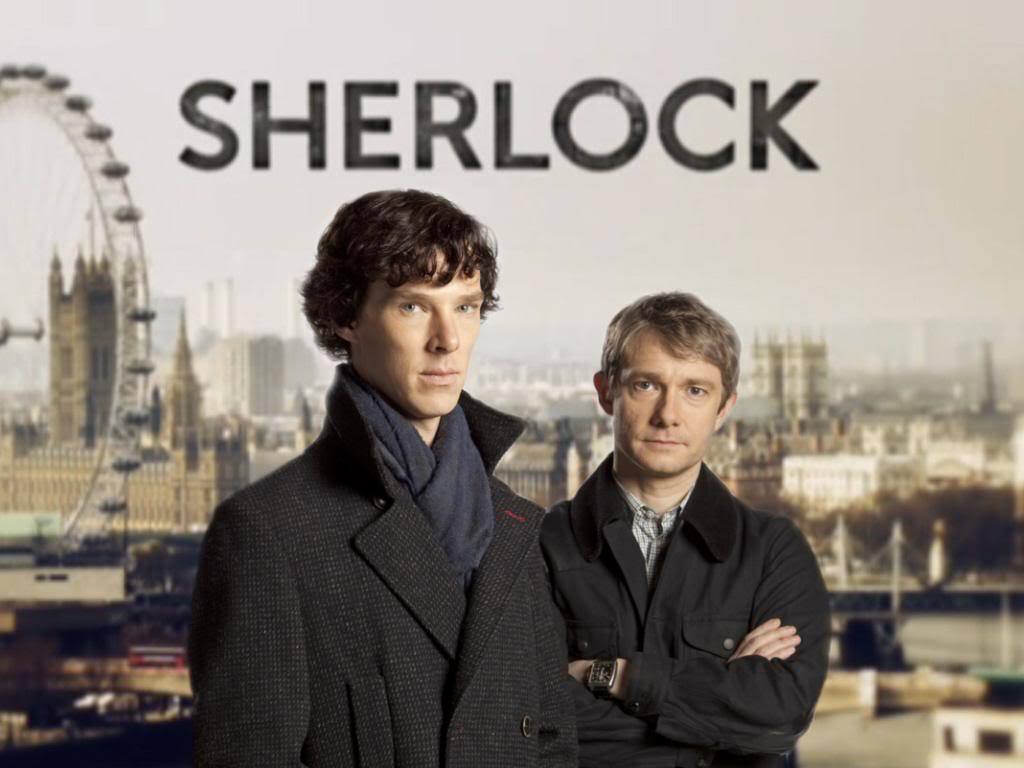
"Sherlock" and Female Characters

Since starting tumblr, I have had a lot of GIF-based exposure to shows that have very active and passionate fandoms and one of the most active fandoms that seems to always come up when talking about tumblr is the Sherlock fandom. Doctor Who is also very popular among the people I follow but I already watch that and Downton Abbey appears quite a bit but that was already on my to-watch list by the time I started seeing it everywhere, so Sherlock was the one that intrigued me from a perspective of knowing nothing about it.

I consulted my friend Sarah on the subject since in the last few years she has become my authority on British television and I figured since it was so popular she had probably seen it. Her response was pretty much, "It's okay. It's really amusing but it doesn't really deserve all the tumblr stuff it's getting. You'll have a problem with how the female characters are written." That last bit set off a warning signal in my head because a lot of the time, writing is the most important thing to me about things I watch and Sarah, like me, cares a lot about how female characters are written since, let's face it, a lot of people don't know how to write female characters.

As you would be able to tell from reading . . . anything else I've written, two of the fandoms that I spend the most time in myself are the Fullmetal Alchemist fandom and the Whedonverse and you know what these both have in common? Well written female characters. Fullmetal Alchemist is a story written for the teen boy demographic that is mature enough to appeal to all ages and genders. It is also written by a woman, a fact that alludes a lot of people because she pulled a J. K. Rowling and adopted a unisex, verging on masculine pen name, Hiromu Arakawa. In spite of the nature of the story requiring there to be notably more male than female characters, there are plenty of women represented and they are all unique, strong, and three-dimensional, even minor characters like Mrs. Bradley and Rebecca Catalina. You understand who they are and what their motivations are and they are neither saints nor devils. Joss Whedon and his squads of writers are also triumphant at writing shows where there is a female main character half the time and the ensemble cast is always made up of nearly equal parts men and women. His women, like Arakawa's, are unique and three-dimensional, and strong in their own ways.

Now, I should be clear that when I say that a female character is "strong", I don't necessarily mean that in a physical sense (or even an emotional sense). She is most definitely not flawless. It's the flaws that make a female character strong and three-dimensional and if she doesn't have any then you have failed character writing 101. The first rule of writing a female character is pretty much to forget that she's female for a moment so that does not becoming a defining trait. There's a fantastic article about the differences in the definition of strong called "Why Strong Female Characters Are Bad For Women" that uses the Transformers movies as an example of how not to write women and talks about how a lot of men seem to misinterpret the phrase "strong female character" into a character that is a flawless expert in some field who is sexualized in a way to appeal to the male audience.

Let me take a moment to get back to Sherlock because I do have good things to say about it. I found it entertaining, extremely well acted, and beautifully directed. These elements alone make the show of a very high caliber above a lot of the tripe you are likely to see on television nowadays. It is definitely a good show. The problem comes in with the writing. While, the show is adapted very well, taking Arthur Conan Doyle's original stories and moving them up to a modern setting, there are some aspects of the writing that irk me. First of all, I was really uncomfortable in the first episode and in many of the subsequent episodes at how many times humor was attempted to be derived from a "gay gag" involving Sherlock and Watson. The first time I laughed a bit but every time after that started to get more and more uncomfortable by how often the joke kept coming up. I started thinking to myself, "Does the show think there is something inherently wrong about two men being roommates? Does it think there is something funny about being gay or being mistaken for gay?" On top of those jokes, the show needed to make it ABUNDANTLY clear that both Sherlock and Watson are straight. Watson is dating girls left and right and Sherlock, in spite of the fact that he seems to be written in a way that would make him make more sense as an asexual (although perhaps not aromantic), is given a love interest as well and his lack of sex becomes a topic for discussion on more than one occasion. There was something a little off about the whole situation to me.

There are other small writing complaints I have about the show that are kind of omnipresent in Steven Moffet's shows like that occasionally things are wrapped up in a way that makes no sense and gives no real explanation for ("A Scandal in Belgravia" was full of these) but when these things happened I tried to just tell myself to ignore it instead of getting angry about it.

Then we enter the thing Sarah warned me about: the female characters.

I think it's probably best for me to break this down one by one to say exactly what is wrong about how the female characters in Sherlock are written.


Dr. Sarah Sawyer

Honestly, I found this picture on a Sherlock wiki and read the whole ten sentence description of her and there wasn't a single element on the page that said a thing about who she is. She is a characterless character. Then she gets captured, like all useless women do in fiction. In fact, she is the first in what will be a string of useless women only around to date John and remind us that he A.) isn't gay and B.) can't hold down a relationship because of the chaotic life he leads. Wouldn't it perhaps be more interesting and emotionally compelling if we actually knew who she was? What if she made some appearances in other episodes and the audience started to like her as a character and then she and John broke up because of the aforementioned chaotic lifestyle and we actually got a real impression of how much John's friendship with Sherlock is affecting his private life? Even if a character does exist for furthering the development of a more important character, this does not mean they should just be a figure no one will remember. I couldn't even remember her name until I looked it up on IMDb.


Sgt. Sally Donovan

And while we are on the topic of useless female characters, we have Sgt. Donovan. I didn't even know she had a first name until just now. Sgt. Donovan is around a bit more than Sally and actually has the barest minimum requirement of character to have appeared in three episodes out of six. Here's what we know about her: she hates Sherlock because he likes crime and she thinks he's going to turn into a crazy murderer and at one point she had sex with one of her coworkers which was clearly played for laughs. That's all I've got. It's all well and good to have a detective character who thinks Sherlock is overstepping their boundaries and could even be dangerous, not everyone on the force is likely to have Lestrade's tolerance for him, but I feel like there's something missing from all this hatred. Shouldn't there be some kind of experience in order for her to draw this assumption? A past case? Something Sherlock himself did? Also, why is she always angry? Seriously, every scene she is in, she is pissy and angry. She's certainly around enough to become a real character so why hasn't she become one yet? Any real trait to show she's a person would be lovely.


Mrs. Hudson

Mrs. Hudson is probably the female character I have the best understanding of. I don't necessarily mean she is the best developed character or that she's the best written female character (although, truthfully, she may be). What I mean is that I understand and accept her purpose and why she is written the way she is far more than I understand and accept the logic behind the other female characters. Mrs. Hudson is a parody of the landlady caricature. It has appeared enough in literature, film, and television: the older widow who is very sweet and protective of her tenants and likes to meddle in their lives. The parody aspects comes in with the fact that no matter what utterly ridiculous thing Sherlock has done, she still maintains that sweet, concerned nature typical of her caricature. Finds a severed head in Sherlock's fridge? Scolds him that he put it in the same place where he keeps his food. We even get to see a bit more of her strength in the scene where she exercises her acting chops for Sherlock's sake. We don't ever really get an explanation for why she is so cool with Sherlock's weirdness and I kind of wish we did because I think it would be really interesting and would kind of fill in a missing piece to her character but I'm not going to hold my breath. The writing of the show in general doesn't care much for filling in missing pieces and I doubt they would waste their time on a character who is just a parody and comic relief but since she is the most easily likeable female character on the show, I wish the writing would acknowledge this more.


Molly Hooper

Poor Molly Hooper. I'll get to her character in a second (although that statement sums up most of it) but I would like to point out something about all these female characters that is easy to overlook: they are all gainfully employed. You have a doctor, a detective, a landlady, a pathologist, and (as we will get to) a high class dominatrix. These women are all implied to be intelligent by virtue of their occupations and/or success in said fields. This is another one of those female character writing problems: equating a good job or job success with strength. In spite of most of these women's careers, many of them are so lacking in character that the job doesn't make them any more of a character.
Now Molly. I want so hard to like Molly but I always just end up pitying her. Like Mrs. Hudson, she appears in the show a lot because her career is important to the lives of Sherlock and Watson but Molly for 95% of the show spends her time pining after Sherlock and getting rejected over and over again. She's the Eponine. In spite of this unfortunate role she was saddled with, Molly has actual personality traits: she's friendly but kind of awkward, she has a high tolerance for the disturbing, and, as I was overjoyed to hear, she is very perspective to people's feelings that they keep hidden. Molly's most significant moment on the show is definitely at the end of season two when she reveals herself to be the only person who is really capable of seeing beyond Sherlock's exterior traits. She explains that her father was the same way, which actually makes sense, and in a way this explains her attraction to Sherlock the entire time. She likes him because of the potential she sees underneath as well as the exterior. After having nearly sat through the entire show without seeing any kind of development in any of the female characters, this was a breath of fresh air and I sincerely hope that Molly will be given more to do in season three. This is an important development in both her character, Sherlock's, and their relationship and I am terrified that this will be abandoned by the writers for something that they deem more important. I would love to see a kind of friendship or even therapist-patient relationship crop up here. I'm rooting for Molly's development!


Irene Adler

The sound my frustration makes is: Auuuuuuhhhh. I don't even know where to start here. The original Irene Adler was an American opera singer who had some high profile affairs. She's clever, sexy, and international and in some materials is a sort of love interest for Sherlock. Now imagine that you have to take that information and put it in a modern context. When I do that, I get Irene Adler as a lead singer of a rock band or a pop singer who has had a lot of high profile affairs who has connections everywhere in the world because of all the touring she does and manages to be famous but lead a sort of double life where what is published in the papers doesn't even graze the surface of what she has really done. Now put that through a "poor male writing" filter and what do you get? You get Sherlock's Irene Adler, a famous dominatrix who has incriminating pictures of a female member of the royal family who is a client of hers and has connections around the world. Now, I can't stress this enough, the problem is not that she is a dominatrix although it is a fairly poor translation of the original material. I'm no prude and I have no damage against sex workers. It's also by no means impossible to write a female character who is a sex worker who can be liked by both sexes (Inara Sera from Firefly anyone?). No, the problem is how her occupation affects every other aspect of her character. As I said before, the female characters of Sherlock are all well employed but their jobs don't really define anything about them. This is not the case with Irene. The dominatrix thing comes into play all the time with her speech and behavior. She is almost always overtly sexual which makes her kind of hard to relate to and makes it hard for any other personality traits to seep in. The virgin-whore complex is in full form here with Molly as the pathetic virgin and Irene as the male fantasy whore. I think she would have been more appealing to a female audience if she was a dominatrix but treated her work like a private thing that doesn't factor into her personal life. Then there's the matter of her cleverness. Like the article I referenced before, one of the defining traits of these poorly written female characters is their expertise in a field where they trump all their male counterparts, made okay to a male audience by their sexuality. Although Sherlock does ultimately defeat Irene at the end, she outsmarts him throughout most of the episode she's in and does so in ways that Sherlock can't even comprehend. Also, this is utterly besides the point but I was also kind of hoping Irene would be American because the representation of Americans on Sherlock (and Steven Moffet shows in general) is absolutely atrocious. They are either violent, bigoted, or stupid or any combination of the three.
I think what makes me most sad about Irene is that while Molly has shown signs of being a retrievable character, I'm not sure if Irene is. It's totally possible that she could come back into the show, humbled by her defeat, and become a character everyone could really love but I guess I'm a bit cynical.


Dear Steven Moffet,
A homework assignment: before season three of Sherlock, please watch any two Joss Whedon shows and read at least 3/4 of Fullmetal Alchemist, paying close attention to the female characters and then attention to how they are written in comparison to the male characters and how they function in relationship to them.
- Kay

Thursday, January 10, 2013

The First Episode of "Angel" From Memory.

In the not too distant future I will be doing my annual post on movies nominated for Oscars. Usually I finish it somewhere in early February after I have managed to see everything nominated in the four major categories and a portion of the animated and foreign films as well. I'm starting off strong this year with three Best Pictures, three animated, and one foreign under my belt already (usually I start off with way less).

But for now, let's get silly.

So about two weeks ago I decided I wanted to watch some episodes of Angel, frequently my default activity when I don't want to start a new series, can't find any movies I want to watch, and have left whatever book I'm reading in my desk at work. The problem was that I couldn't think of an Angel episode that I hadn't seen recently. It took me a second to realize that the answer to my question was the first nine episodes of the series. Then I had to contemplate why I not only haven't watched them recently but haven't watched them at all since I first saw them maybe five years ago and never watched them in the correct order because I was using streamed videos on a DSL internet that would load at irregular times.

Did I think the episodes were boring? Well, no. "Monster of the Week", yes but not necessarily boring.
Did I just not like Doyle? No. I really like him. I really wanted him and Cordelia to get together. The only main character on Angel who I don't absolutely love is Connor (I actually kind of hate him).
So was I avoiding the episodes because it would make me sad? Perhaps a bit but there's a bigger reason.

Not too long ago I rewatched all of Angel except those episodes and now I remember why: The essay I wrote about Wesley and Fred. I watched season three of Buffy and then skipped ahead to episode 1.10 of Angel because that's where Wesley comes in. I didn't need those episodes to write the essay so I didn't watch them.

I'm watching them now and actually dreading getting to episode 1.9. Sobbing may happen.

So here's my tribute to those episodes I didn't talk about in the Wesley/Fred essay: a summary of the first episode of Angel pulled completely from my very flawed memory.


1.1 "City Of"

Angel: Los Angeles . . . Well, let's save some people.

(He does.)

(Returns home to the lair of the Caped Cadaver.)

Doyle: Hi!
Angel: How'd you get into my house?
Doyle: Not important. I'm here to exposit your backstory!
Angel: Oh come on. Like anyone needs that.
Doyle: Hey, there could be random stragglers who've never seen an episode of Buffy and have no idea what you're about. Don't get all high and mighty. No one knows who I am either.
Angel: Yeah, who are you? You're like every sketchy Irish character Joss Whedon has written with a dash of Xander Harris.
Doyle: I resent that! I was practically the original sketchy Irish character, minus yourself of course, and I'm way more interesting than Xander bleeding Harris. I've got a ton of backstory and layers. I just hope I'm on the show long enough to reveal them.
Angel: Well, you're not human. I can smell that much.
Doyle: Hey, I happen to be very human . . . on my mother's side.
Angel: So other than telling me my own life story, why are you here?
Doyle: I had a vision that told me to come here. The Powers That Be give me visions of people in need, which are like violent migraines with pictures, because blah, blah, blah redemption. It's a big theme, you know? Problem is, I'm not a fighter as you can probably tell, outside of bars at least, . . . but you are. So why don't you buy me some booze and I'll tell you about the latest helpless human.
Angel: I don't know of any demons that thrive on alcohol.
Doyle: That's my human side.

(They wander the streets of L.A. Doyle drinks and yells at homeless people)

Doyle: See that waitress in the coffee shop? Go save her.
Angel: She looks fine.
Doyle: Well, she isn't. Go chat her up.
Angel: Why would a random woman talk to me?
Doyle: Have you seen you? (First of many Ho Yay moments between Angel and Doyle)

Angel: Hey.
Girl: Come to a swanky party with me?
Angel: Sure?

(At the party.)

Cordelia: OMG, Angel! Still a vampire?
Angel: I can't really get rid of that.
Cordelia: Right. Well, I'm gonna go talk to important people because my life is SO wonderful.
Angel: . . . I'll never see that girl again.

(A vampire named Russell Winters who was at the party kills coffee shop girl.)

Angel: NOOOOO, I failed!! (emos)

(Later. Cordelia's shitty apartment)

Cordelia: My life sucks ass. I can't get work and I can't afford food.
Friend on Phone: Russell Winters wants to meet you!
Cordelia: An investment guy?
Friend: Just do it. Connections and crap.
Cordelia: Okay.

(At Russell's mansion)

Cordelia: (exposits backstory becoming depressed with her own tale)
Russell: I can make the pain go away.
Cordelia: Wait a minute, you're a vampire!
Russell: No, I'm not.
Cordelia: Yes, you are! Don't fuck with me; I went to Sunnydale High. Killing vampires was practically a graduation requirement.
Russell: RAWR!
Cordelia: AHHH!

(Angel saves Cordelia but Russell gets away.)

(At Wolfram & Hart office.)

Angel: Huh. Evil law firm. The joke writes itself.
Lindsey: Get out of here.
Angel: This is Sparta!

(Kicks Russell out the window so he burns up in the sun.)

(At the office)

Cordelia: Hi!
Angel: Jeez, how do you people keep breaking into my secret lair?
Cordelia: I cleaned up and made some terrible coffee and I'm your new secretary now so you have to pay me weekly. 'Kay, bye.
Angel: . . .
Doyle: We should let her stay.
Angel: You think she's hot, huh?
Doyle: (says something to imply that she is boner-inducing. Might have been "stiffener" or "stiffening." And now that I think about it you could take that to refer to one's spine and not one's penis but since it's Doyle he probably means penis.)

(END ON UNNECESSARILY EPIC POSE OF ANGEL STARING DOWN AT LOS ANGELES.)


I'm sure that was very useful.

(Exit Kay)

Saturday, December 29, 2012

Some Thoughts on the "Les Miserables" Movie

So I saw the movie last night with my friend Alex and I wanted to get out my brain spew before the inevitable occurrence of talking to other people happens and I am bombarded with opinions other than my own. Right now, my brain is fairly fresh as I think the only things I know are that I am vaguely aware of the movie's rotten tomatoes rating (somewhere in the low 70%?) and I know that a lot of people on my tumblr dashboard who love the musical were very, very upset but my friends who love it seemed to think it was okay.

Confession time: I haven't actually seen the FULL stage show. I saw the shortened stage show that is actually practically the same length, the 25th anniversary concert, parts of the 10th and I know the music by heart learned through repeated listening to the original London cast recording years ago. I have also read the book and it is one of my favorites with Victor Hugo being one of my top two favorite authors as a whole (Kurt Vonnegut is the other one; in case you are trying to figure out what the hell those two authors could possibly have in common, they're both humanists). So that being said, I would say that overall, I liked it. I probably give it 3.5/5 stars which is generally the rating I used for "I liked it. It was good" with 4 being great, 4.5 being awesome, and 5 being flawless. The reason for the rating is because I found that there were things I really, really liked and things that really, really bothered me with very few things not on that strict binary.

What I loved wholeheartedly was the art direction and costumes. The sets were gorgeous and really evocative of the time period and feel of the stage show. I felt like the book was coming to life for me in a way that didn't occur when say, I watched the Liam Neeson non-musical version of "Les Mis." I absolutely love things that they included like Gavroche's elephant and the church interiors were all beautiful. As for costumes what sticks out the most is the Thenardier's three costumes changes, each very different and clearly showing both their station and their bombastic flair. From a visual standpoint alone, everything was beautiful and nothing hurt.

I also loved all the attention to detail and little callbacks. When Javert is singing "Stars", he is shown walking along the edge of a roof, a scene that is evoked again when when he is singing his suicide song and teetering on the edge of the bridge with an intent to jump. When Cosette is talking to her father in his bedroom, the silver candlesticks the bishop gave him are prominently displayed on a side table. There's also the inclusions from the book that according to my only available authority on the matter at the time (Alex) aren't in the stage show. Marius' grandfather appears and their relationship is given a brief albeit informative back story. The scene with Lamark's funeral being the start of the rebellion is included and given a bit of reasoning. Alex also told me that everything after Valjean and Marius escape from the sewers is more clearly laid out. Also, I have to mention the ending scene. As Valjean was dying, I started wondering how they were going to do the ending reprise of "Do You Hear The People Sing?" and they did it excellently with Valjean essentially entering a heaven where there is a giant barricade across Paris. While I am sometimes not happy with "showing heaven after death" scenes, this one didn't feel contrived. It also perfectly tied in the themes of hope so well with the song lyrics combined with the symbolic barrier. Hugo would have been happy with it, I think.

I was okay, perhaps leaning more towards pleased, with the way the songs were ordered and what was cut. Eponine sings "On My Own" earlier than she does in the show which actually cuts the bit where she talks to Cosette herself and this was one of the things I would have been more unhappy about had I not developed a desire to not have Amanda Seyfried sing more than she had to. Same with how they cut "Dog Eats Dog" entirely. I would have been more sad if I hadn't been okay with the fact that Sasha Baron Cohen is not a singer, but plays the role well. The one thing I actually was kind of missing was "Little People" solely because it makes Gavroche singing it when he dies collecting gunpowder feel more random than like a dark reprise which is what it actually feels like in the show. However, they shorted "Castle On A Cloud" which was good because that song is boring and I love that they moved forward "One Day More" and pushed "Do You Hear The People Sing" to the scene where they actually start the riot. In the show it has always felt unnecessary to me to have "Red and Black" and "Do You Hear The People Sing" back to back even though both songs are absolutely necessary to the show at large. There where a couple times where lines were flip-flopped and it messed up the rhyme scheme which irks me but I can deal with it, particularly because there were also times when lines were changed to be more descriptive than the previous ones so it balances out. The inclusion of the new song "Suddenly" was not offensive or anything, just unnecessary. I don't have any feelings about it.

The thing I was displeased with was the direction. I loved Tom Hooper's directing of "The King's Speech" but here it was clear that he was out of his element. To quote Alex, "Directed by Tom Hooper, guest directed by Steven Soderbergh". It was very clear that there were some things he could do and some that he could not. All the choral songs were wonderfully directed. "At The End Of The Day" had a lot of quick cuts but it really had great movement and felt natural with the song. "Turning" was a nice slow pan out of women cleaning up the blood on the streets as they sang. All the war scenes and large crowd scenes were great as was the final song of Valjean's death. The problem mainly appeared when it came to shooting solos. Almost every solo, especially every really heartfelt tear-jerking solo was shot in the same exact way: close up of the actor's face slightly to the right of the scene with negative space to the left. By "Empty Chairs at Empty Tables" I was screaming, "ENOUGH." The only solos that were well shot were Javert's which actually had life and movement and composition (there was one lovely shot in particular of Javert on the ledge in the right part of the frame and Notre Dame in the left; reference to other Hugo books?). I get that he wanted focus on the actor's reactions over all else but when the same technique is used that many times, it loses all meaning. There were also other directional decisions that were really odd. There is one quick shot of Valjean and Marius talking that has a tilted camera for absolutely no reason at all except to make the audience tilt their head in both confusion and to see the scene better. When the camera pans up on Gavroche's dead body, it looks like he's slipping out of the frame. Sometimes an actor would move and the camera would seem to be a few seconds late in catching up to them. Then there was the brief but memorable shots of extreme shaky cam when the boys are running into the cul-de-sac that made me so motion sick I had to shut my eyes for a second.

Aside from the shots themselves there was another particular directorial decision I have to address. There were a lot of actors who did the, "unable to sing properly because I am overcome by emotion" thing which was mostly effective but there were a few times when it got absolutely excessive to the point where it was a real hindrance on the actor's volume, diction, and rhythm. Actually, especially rhythm. At first I thought this was just a thing Anne Hathaway was doing which is smart because she is an actor first and not a singer but then where I realized that absolutely everyone was doing it, I decided that someone told them to do this and there were a lot of times when it should have been toned back. The scenes in particular that come to mind are when Fauntine is hallucinating Cosette, a lot of Valjean's solos, and the first half of "Empty Chairs At Empty Tables."

Now we get to the actors specifically, the quality of which works strictly on a person by person basis and occasionally even a song by song basis. Now, I am not going to get super hung up by the fact that half these people are really not Broadway voices because it really doesn't matter for most of the parts of this show and it's a movie anyway that, like I said in the previous paragraph, chose to put acting performance above traditional quality of singing. But I will call shenanigans when I see it. I'm going to try to go based on time of appearance but it might be a bit looser than that.

Hugh Jackman as Jean Valjean was fine. Just fine. I had no real expectations of him but during "What Have I Done?" I started to get sincerely worried. I felt better as time went on although his "Bring Him Home" could have been better. I think that song is really the test of a Jean Valjean. If you can nail that, you can probably nail everything else. A lot of his songs had very odd rhythm that didn't follow the music well and this was a constant annoyance. Overall, fine.

Russell Crowe gave a poor performance of Javert. He couldn't act and sing and the same time and didn't really do either anyway. The word that comes to mind is flat: flat performance and singing that literally didn't stray from about one and a half octaves. He was bland as bland could be and the part really should have been recasted.

Colm Wilkinson as the Bishop was obviously perfect although the second he started singing I was like, "Holy crap! It's two Jean Valjeans!"

Anne Hathaway as Fauntine was actually surprisingly great. I didn't have doubts about her like other people I know did but I was pleasantly surprised. She has a good voice and her performance itself was really moving. I almost started tearing up during "I Dreamed A Dream" and I never tear up from that song because it is practically a cliche at this point but her acting was just so powerful, I couldn't help it. I think she's working for that Oscar.

Isabelle Allen as Young Cosette was fine. She was only in it for a second and she sung perfectly fine.

Sasha Baron Cohen as Monsieur Thenardier was the right casting choice from an acting perspective no doubt about it. Thenardier isn't really a "singing" part so there was no real pressure for him to do particularly well there. He just had to be funny and he succeeded. The one problem I had with him was that during "Master Of The House" he adopted this weird semi-French accent that sounded more like Borat than anything and was so incongruous since everyone else has either a British-ish (usually cockney) accent or has no accent because they are singing and that usually diminishes an accent.

Helena Bonham Carter as Madame Thenardier . . . well, it makes sense from an acting perspective but goddamn if I'm not sick of hearing her try to sing. I think she somehow was even less impressive here than in "Sweeney Todd". She needs to learn how to project and her diction could use so much work. If I didn't know the lyrics, I would have no idea what she was saying during her bit in "Master Of The House" (although side note: I love the staging for her bit in that song with her flirting with the guy as she robs him).

Amanda Seyfried as Cosette was notably not good. Her acting was fine, I guess. There's not much to act in the role of Cosette really. Her vocal tone was fine too. The problem was that she missed the correct note about half the time. She was frequently sharp and it was painfully obvious. She didn't even really have any moments when it could be blamed on being overcome with emotion.

Eddie Redmayne as Marius, like Anne Hathaway, was a surprising standout. Prior to seeing the show I had heard him sing "Heart Full Of Love" and I was really worried but when I actually heard him sing other things, he was really good. I had a bit of a problem with the first half of "Empty Chairs At Empty Tables" because he sang it so softly without any real buildup so when it actually gets to the big belting moment, it came out of nowhere but I may be a bit critical because it's my favorite song. His voice also had a really interesting, unusual tone which went well with his unusual looks.

Aaron Tveit as Enjorlas was obviously fantastic. It's funny how much his voice stood out as a Broadway actor over the regular actors.

The same could be said of Daniel Huttlestone who played Gavroche and was great. No surprise that he has played the role before.

Samantha Barks as Eponine was very good but I felt like she was holding back a bit. I feel like her performance at the 25th anniversary concert had much more of a punch to it although she still got me a bit choked up during "A Little Fall Of Rain". Perhaps she was hungry. Seriously, her waist is terrifying in that dress. Give her a cheeseburger.

Everyone else mostly did fine: the ABC Society, the factory workers, the whores, that guy who says, "You have no friends". The convicts were mostly unintelligible though. The loud sounds of the crashing waves did not help. It was another reason I was worried about the movie in the first couple minutes.

As I said, overall, it wasn't bad. I liked it. It could have been better but it could have been worse. I think a lot of the negativity that I am finding towards the show comes from people who had very high expectations, people who think it can't live up to the stage show, or people who are expecting to be floored by the singing and these are all bad ways to go about it.

*Life Tip Of The Day: Always go into something expecting nothing. Especially movies. I saw "Django Unchained" on Christmas and all I knew about it was that Quentin Tarantino directed it. I loved it. Just saying.

And now, off to ruin the purity of my thoughts on the movie by looking at what other people think.

**UPDATE: Flixster (72% tomato rating in fact) shows a distinct difference between people who loved it and people who were notably disappointed. I'm a stand alone as a 3.5/5 rater. Oy, the internet debates that have probably been going on.

Saturday, December 15, 2012

John Green Is An Amusing But Frustrating Author.

So I think I should get this out of the way first: John Green, the person, is awesome. He's hilarious and clever and incredibly quotable especially in the departments of "being a nerd" and "relationships." I have seen every episode of Crash Course: World History and a rather notable share of his vlogbrothers videos (as well as many by his brother, Hank Green). Hell, one time I even sat my mom down and made her watch his "How To Make A Baby" video and I never share anything with her. Plus, there's the fact that he's a Christian humanist which, as a secular humanist myself, fills me with joy whenever I find religious people who are also humanists.

So yeah, I think John Green, the person, is pretty awesome. I'd still never approach him on the street but I'm a colossal bag of awkward so that's more a comment on me than anything (one day ask me about all the famous people I have encountered in New York and had absolutely no balls to talk to). And as a fan of John Green, the person, I made it my mission to read his books. Yes, that noun was always plural.

So I ventured to the library and, as my usual frustration with my town's library goes, I was unable to procure Looking for Alaska, John's first young adult novel. Luckily, the day was not a failure as I did manage to find Paper Towns. The second I got home at around seven, I started reading and I was finished in the evening the next day. I thought it was really a fantastic read: very smart, likeable and interesting characters, a writing style that sounds like John Green talking, and a plot that kept me turning the pages with no effort. When I finished, I went onto goodreads.com, as I do, rated it, and read reviews. The positive reviews were mostly people talking about how awesome John Green, the writer and person, is so I ignored them. As it goes, the negative reviews were much more interesting. Most of them complained about the characters being too much like his other characters which, since this was the first book I had read by him, I didn't fully understand but it made me wonder what was in store for me the next time.

The library was kind to me and I managed to find Looking for Alaska the next time I tried. It took me a bit longer to read, maybe four days off and on, and when I finished I was conflicted. Like, "My feels!" conflicted. Yes, it's a sad book but it wasn't the sadness that pained me. What pained me was the fact that A.) I could see exactly what those reviewers were saying about the characters being too similar but B.) I HATED these characters so much in direct contrast with how I felt about the characters in Paper Towns but C.) I understood that I wasn't supposed to necessarily like them. And yet, and here's where the problem comes in: I really felt that it was the stronger book from a thematic and plot-based standpoint. The only thing I wasn't conflicted about was that the book had the funniest blow job scene I have ever read and probably will ever read and at least that cannot be taken from me (I photocopied it and read it aloud to my friends with voices; I can't do a Romanian accent at all). My hatred of the characters for being both unoriginal and unlikeable deeply conflicted with my feelings on theme and plot and as a book person myself, I eventually had to admit to myself that Alaska was far superior.

Next came Will Grayson, Will Grayson which I thought was okay but had a lot of faults, particularly in John Green's half of it, most notably those same character types appearing again and a romance that kind of distracted from what the book really seemed to want to say.

I just finished The Fault in Our Stars and I have to say I feel a little better about John Green, the author (the book, on the contrary, made me sob during my lunch break in a good way). It had a lot of the same things to complain about as before but it did feel fresher and newer than the others and for that I have hope.

If you're wondering why I haven't read An Abundance of Katherines, I have been unable to find it in the library. If you're wondering why I don't just buy it since I seem more on the plus side than the negative with John Green's books, it's because I can tell from the plot synopsis that even if it is good (which reviews don't seem to tell me), it's unlikely that I will like it more than Alaska or Stars. I like the tragic. It's how I roll.

But here's my main point: John Green can write a good novel. He has written Great novels. Alaska and Stars are novels I will read over and over and push on other people. But he has a notable problem with repeating himself in the way he writes his characters. There's having a style and then there's having a formula and John Green has developed a formula when it comes to his characters which can be a difficult thing to get past after reading more than one of his books.

It is in no way debatable that John Green can really write a smart book with an unpredictable and interesting plot. And that's why I'm so angry by the flaws.


SPOILER ALERT. YOU HAVE BEEN WARNED.


Frustration: Characters

The John Green Character Set is an easy to deconstruct machine that applies to all 3.5 books by him that I have read except The Fault in Our Stars which is slightly different.

1. First you have the protagonist who is a sixteen year old boy. He is considered kind of a nerd, awkward to varying degrees, and has a good relationship with his parents and no siblings. In spite of his awkwardness, he is often rather clever in his speech and is usually subtly stated to get good grades and be one of the "smart kids." He is interested in a girl who will change the way he looks at the world.
Variations:
* Miles of Looking for Alaska is the biggest outcast of them all, apparently having no friends before switching schools which seems to be the only risk he had taken in life until that point. He wants desperately to fit in and seems rather prominently out of the loop with modern culture.
* Quentin of Paper Towns isn't much of an outcast at all. He has a solid group of friends and seems to have a lot of acquaintances and an ex-girlfriend but he takes pride in avoiding social conventions like prom. This distaste in high school culture gets stronger as the story goes on.
* Straight!Will of Will Grayson, Will Grayson has a flat out code about preventing himself from being a part of life although his aversion to feeling feels is never given a real explanation (trying to reduce his presence do to the overwhelming presence of his BFF?). He has to learn human feelings and does by the end.
[N.B. I'm kind of convinced this character is John Green himself or, more accurately, how John Green perceived himself as a teenager.]

2. Then you have the second most important character: the girl. She is pretty (often hot), curvy, very clever and funny. She's a terrible driver and has an interest in books and/or music and often has some poem that she thinks is very important. She is also kind of unpredictable because someone screwed her up and usually kind of pretentious. Oh, and she's taken. Sorry, protagonist.
Variations:
* Alaska of Looking for Alaska is this to a T. The important difference with her versus the other girls is that it is not just that she does random things, her moods are erratic as heck and she is often moody and bitchy. She's also really bad at being faithful. These unlikeable things about her are part of what creates one of the themes of the novel. Also, Miles never really gets her (neither romantically nor understandingly).
* Margo of Paper Towns is less screwed up than Alaska but with her we never find out why; just that her parents don't know how to treat her. We never see her drive but we do know that her unpredictability is not negative and is usually on a more grand scale for amusement purposes. Quentin only sort of gets her but he definitely understands her.
* Jane of Will Grayson, Will Grayson is very toned down from the other two. She's not necessarily unpredictable and instead of a poem she has a scientific theory. Jane is kind of the others only so much more safe and nice and unlikely to do something absurd. She's kind of boring in comparison. Will gets her but, in this case, Will and her is not really the most important part of the story.

3. Then you have the best friend of the protagonist. The best friend is the yang to the protag's yin. He is outgoing and energetic and actually understands the way high school works and wants to be a part of it. He acts as an important foil to the main character to support the theme.
Variations:
* The Colonel of Looking for Alaska is pretty much Miles' guide to the school, introducing him to his crew of friends and telling him who to avoid. He acts as the foil to Miles after Alaska's death because while Miles wants to live in his fantasies of her and not truly understand who she was and why it would happen, the Colonel forces him to consider why and face the hard truths.
* Ben of Paper Towns is the foil to Quentin because while Q becomes increasingly more detached from high school society, Ben becomes more of a part of it, feeling complete by finally fitting in and dating a popular girl.
* Tiny of Will Grayson, Will Grayson is a foil of Will in that he is not afraid of who he is or getting involved in people and love but what makes him distinct from the other best friends is that Tiny actually has a more important story than the girl of the story. In fact, in one school of thought, Tiny could easily be the main character of the whole book over both Will Graysons.

4. The other, sometimes best, friend of the protagonist. Often they are the most logical minded of the three guys, pointing out when the other two are going to do something that wouldn't be good. They are also a minority in some way.
Variations:
* Takumi of Looking for Alaska is one of the main schemers of the group but his most important moment comes from the fact that while the Colonel and Miles are suffering from Alaska's death with each other, Takumi is living in his own pain with the same guilt as them and they don't find out until much later.
* Radar of Paper Towns is the intermediate between Q and Ben. He does not get swept up in their new found popularity but he doesn't alienate himself from high school society. He is also very aware of where both Ben and Q lie on this spectrum.
* Those two guys of Will Grayson, Will Grayson don't really have a role aside from padding out the cast. Also, while the other two characters I mentioned are ethnic minorities, these two are gay which, in this book, puts them in the majority but puts them in the minority in reality.

5. There is also sometimes a token other girl. She is usually friends with the main girl and is a part of the group by dating one of the guys in it. Specifically you have Lara of Looking for Alaska who is friendly with the group and then dates Miles briefly and Lacey of Paper Towns who is Margo's best friend and dates Ben. Will Grayson, Will Grayson didn't have one.

***Exception.
The Fault in Our Stars doesn't quite fall into this pattern but it does maintain elements of it.
* Hazel is the main character and she does have some things in common with her male counterparts. She is kind of awkward and separated from regular teenage life but this is because of her cancer, not really because of her personality as far as we can tell. For this reason, she also has a close relationship with her parents. She has the same elements of being clever but considering things like that she got her GED and is in college, this doesn't feel too random either.
* Augustus is her love interest and in this case that is very literal. Most of the main relationships in the other books aren't really love and the book is about the main character understanding that, but this one is a love story. Augustus also has similar elements of his female counterparts. He's hot, drives poorly, and is clever. He isn't screwed up, however, and while he is definitely pretentious in his actions (he's very concerned with the metaphorical implications of things), his interests aren't. He likes video games and novels of video games and used to play basketball before discovering that he hated it.
Hazel's interests are actually closer to pretentious than Gus'. She quotes poetry like Alaska and has a favorite book by a flamingly pretentious author. However, she also spends hours watching America's Next Top Model marathons (those can be addictive). These varied interests of the main characters makes them feel more realistic than some of the others.
* Hazel has the foil best friend of Kaitlyn but Kaitlyn's presence in the story is really minimal even if she does have some amazing quotes about how bangable Gus is.
* Issac, Augustus' best friend, actually has much more presence in the story and he is actually very similar to Hazel in the way he views the world in relation to his disease.
* The other interesting thing about this story is that we get the male perspective in the other novels and we are very aware of the girl they are interested in but we don't have any real comprehension of the girl's perspective of the guy. In this book, because Augustus is hitting on Hazel, we know his perspective on her almost immediately after we get hers on him. Hazel isn't really given any physical description aside from her oxygen tank until Gus comes in and tells her she's hot and looks like Natalie Portman.


Amusement: Structure and Plot

Although John Green's characters may have a tendency to stem from the same basic ideas, his plots and the way he structures them are entirely unique and unpredictable every time.

Take Looking for Alaska. The book is entirely structured around Alaska's death, counting not chapters but the days before and after her death. I wouldn't call her death unpredictable necessarily. There are hints pretty early on in the book that things will not end well for her and the events immediately before are rather obviously looking to it, but the idea to build the plot like that, having both halves serving different but complimentary purposes, is brilliant.

Paper Towns has perhaps an even stranger structure. It is divided into thirds with the first and last sections surrounding the events of a single day and with the middle portion reading at a more traditional pace. The first section is all about the day and night out with Margo, the middle section is all about trying to find Margo, and the last section is about the road trip taken to get to her. The significance of a single day is practically a theme by virtue of the structure.

Will Grayson, Will Grayson obviously fluctuates back and forth between straight!Will and gay!Will with scenes and characters overlapping. The plot I will address in the next section.

The Fault in Our Stars is the most traditionally structured with chapters and no sections but it is fair to say that it falls into a strange space of time for the life of the main character and that's probably why it has such conventional structure. While the book is centered around her relationship with the male character, there are a lot of aspects about it that seem to drop the time into a random space. It takes place after the point in the time that the main character was supposed to die and it ends after her boyfriend dies but on a note that is both a cliffhanger for the future of the character but fully complete from a thematic standpoint. You get the feeling she will die prematurely as she always expected but the book doesn't let it end there.


Frustration: Will Grayson, Will Grayson

Okay so maybe it's harsh to get mad about one of his books, and one that he only wrote half of, but this book had a lot of makings to be good but fell apart for me.

First of all, this book started off as the story of two guys with the same name getting over their similar but different fears of connecting with other people (romantically, mostly). A solid premise there. The interesting thing is that they also get over this fear in the same way: a large gay guy named Tiny, best friend of straight!Will and brief boyfriend of gay!Will. This is all well and good but what got really muddled about this story for me was the fact that at some point it seemed like the story of straight!Will was long over, the story of gay!Will was ending and the story was actually about Tiny the entire time. The finale was certainly about Tiny and not really either of the Wills. It seemed like gay!Will might end up with his new friend Gideon but that was pushed to the side in order to honor Tiny. I mean, technically by organizing the "honoring Tiny" demonstration and dating Tiny/coming out, gay!Will has already grown without needing a new boyfriend but the fact that both Wills seem to have their stories end so much earlier than Tiny's is just strange.

I'm also not sure what we were supposed to take away from Tiny's story. Both Wills have "people connection issues" with gay!Will having depression and being self loathing and straight!Will living his life in the shadow of Tiny but both these issues are resolved with the magic of Tiny setting up straight!Will with Jane and being honest about him through his musical and then dating gay!Will and telling him the positive things he needed to hear. However, late in the story we are introduced to the idea that Tiny, in spite of all of his happiness, feels under-appreciated and pushed aside which is resolved by straight!Will realizing how important Tiny is to him and gay!Will setting up the demonstration with some assistance from a dozen other Will Graysons.

Is the message that everyone is insecure about their relationships, even the confident ones? Hiding parts of oneself was definitely a theme and this would fit.

Somehow I have managed to talk this into making a lot more sense than it did right after I finished the book and yet, for some reason, I am still kind of underwhelmed by the book, mainly John Green's part. Aside from the fact that the most important person to the main character is his best friend instead of a girl, I felt like a lot of the standard John Green character types were present but with less uniqueness and thought than usual and that was rather upsetting.

The most positive thing I can say about John Green's half is the moment when straight!Will realizes Tiny's importance to him and he gives this speech about how much he loves him made me tear up. Even, when he's not at the top of his game, he can sure as hell provoke a response.


Amusement: Theme

If you have to single out the one thing that makes John Green books worth reading, it is quite simply the fact that he writes books that are heavy in themes that really make you think about life. Some of his themes overlap from book to book but each one has a different feel and introduces at least one fresh idea to make you think.

Looking For Alaska:
* Idolizing the dead/False vs. real remembrance
* The impact one person can have
* The mystery of death
* Suffering
* Coming of age

Paper Towns:
* Perception versus reality
* Fitting in/high school society
* The moment you cannot handle life as it is

The Fault In Out Stars:
* Heroism
* Suffering
* Living with dying
* Leaving a legacy/False vs. real remembrance
* True love
* Fate vs. crazy random happenstance


Frustmusement: Dialogue/Inner voice/References 

I have mixed feelings about this combination of things. One the one hand, a lot of the characters seem to have the same inner voice and talk similarly but this relates back to the issues with character. On the other hand, even John Green's sad books have had moments where I was rolling on the floor laughing at the things the characters say. The overall writing is great of course but there are times when the dialogue feels a bit too clever and well planned which ends up disrupting your involvement.

As for references, there are a lot of references to things that John Green loves in his books but I think this is really only clear to people who know about John Green, the person. I love that John Green sneaks things he likes into his books but I can't help but feel like the characters he writes are all Nerdfighters in some weird crossover universe.
Some things I've managed to pick out:
* Listening to the Mountain Goats, John's first, second and fourth favorite band (Paper Towns).
* Going to Amsterdam where John lived for two months (The Fault In Our Stars).
* Saying something looks like conjoined twins, one of John's fields of expertise.
* References to Schrodinger (Will Grayson, Will Grayson).
* His favorite paradox ( The Fault In Our Stars).
* Religious studies class, religion being one half of John's college major (Looking for Alaska).
* Living in Orlando/Chicago/boarding school (Looking for Alaska, Paper Towns, Will Grayson, Will Grayson).
* "This Machine Kills Fascists" is on his laptop and the Woodie Guthrie poster (Paper Towns).
* Nerdfighter Esther Earl and Hazel have the same cancer and obviously she was the basis for the story, The Fault In Our Stars. Even the fact that the author in the story wrote his book to give his daughter a better fictional life seems similar to what John was doing for Esther.
And there's probably more I can't think of.


Final Thoughts:

Read John Green. Seriously. Preferably Alaska or Stars but Paper Towns is good too.
I wouldn't write such a long entry if I didn't love.

And I may have to update this later with my thoughts on Abundance of Katherines because the shape of my Christmas present from my boyfriend indicates that he got me John's box set of books. SO EXCITED. Shh, don't tell him I know.

DFTBA, Nerdfighters.
 

***UPDATE: I read An Abundance of Katherines and I have to say that it is hands down John Green's weakest book. It unfortunately fits the character profile I made up pretty accurately with some slight variations, as there always are. The main character is a prodigy, the girl is actually fairly boring and it seems like he was trying to make her as far from Alaska as possible resulting in kind of a first draft of Margo, and the two best friends are combined into one who is the only character I found particularly likable (and this was a case where we were supposed to like the characters). There were again, really solid themes this time of Fame, identity, community, story telling and remembrance, and what matters to you defines your mattering. The big problem was actually a surprising one: the plot wasn't very good. The premise itself was kind of silly and the whole general idea of hanging out in small town America just isn't interesting to me. The silly premise also makes it hard for the plot to move forward so it just kind of clunks along to a conclusion, not really earning its themes like his other books do. It was still funny and certainly not a bad read but it was rather unnoticeable which is something you usually can't say about John Green's writing and that alone makes it kind of a disappointment.